AI as Infrastructure: Why the Real Pharmacy Revolution Is Happening Behind the Scenes
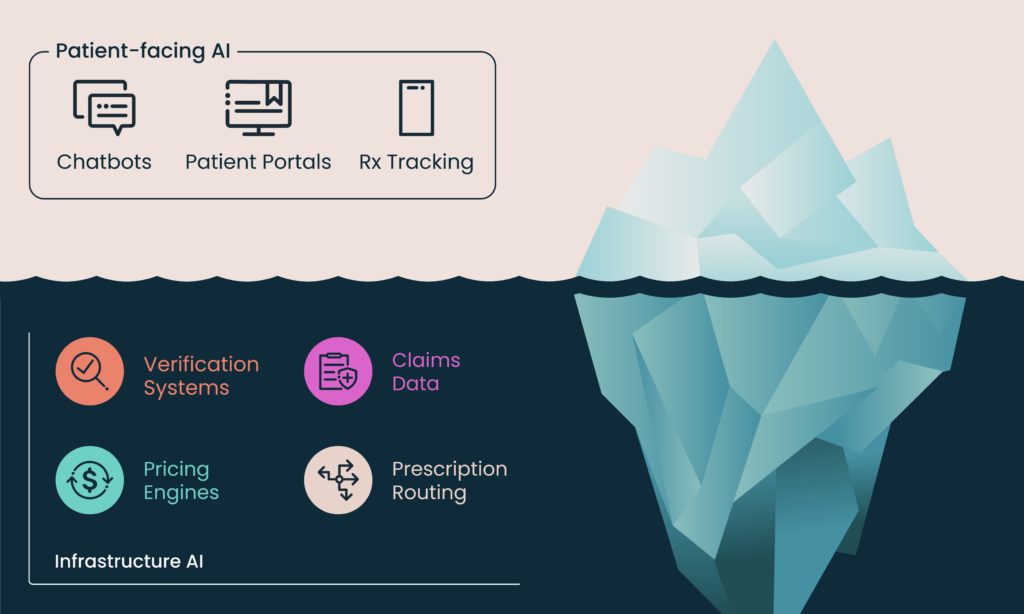
AI’s most visible presence in pharmacy tends to be patient-facing, mostly seen in instances like a chatbot that explains benefits or an app that tracks prescriptions. But AI’s role in pharmacy runs deeper and pharmacy leaders who are focused only on what’s surface-level are missing where AI’s most significant work is happening.
The deeper revolution is infrastructural: how drugs are priced, how outcomes are measured, how prescriptions move through a fragmented system, and how the information payers need to make good decisions gets unlocked…or doesn’t.
AI in the pharmacy space has matured and the most critical use cases are being overlooked. The system is constrained by access to the right data, and the way organizations are figuring out how to source that data will help payers determine what tools are worth the investment. The interface is what patients see but whether it actually works as intended comes down to the infrastructure behind it.
The Maturation of AI in Pharmacy: From Novelty to Infrastructure
Healthcare has had meaningful applications of AI since before the topic was mainstream. What’s changed is that those use cases are maturing, and the scope of what AI can act on is expanding rapidly. Prior authorization automation, for example, now enables systems to review clinical guidelines and patient histories for near-instant approvals, but is also where AI’s growing pains are most apparent.
In a 2025 survey, 61% of physicians said they fear that payers’ unregulated use of AI is increasing denial rates1. This concern has spurred legislative action in states including Texas, Arizona, and Maryland, all of which have enacted restrictions on fully automated clinical denials2. This is a prime example of how applying AI without appropriate oversight carries real risk and real reputational cost for payers3.
The story doesn’t end with prior authorization. The bigger change in pharmacy AI over the past two years hasn’t been speed, it’s been scope. A model used to be built to do simple tasks like flagging a patient likely to go non-adherent or pulling a diagnosis code from a clinical note. Now, the same systems weigh benefit design, prior claims, clinical guidelines, and real-time pricing together, replacing work that used to mean a person logging into three separate portals. This is where we should be paying attention because none of these new developments matter if the underlying data isn’t accessible.
Why Data Access Remains AI’s Most Significant Constraint in Pharmacy
Data access continues to be AI’s biggest limitation in pharmacy today. The benefit information payers rely on most is highly valuable and technically interpretable by AI: deductible status, out-of-pocket maximums, and prior authorization requirements. The problem is that the most reliable version of that information is tightly controlled and accessing it in real time comes with a per-check cost.
Let’s consider the math. Checking six drugs across five pharmacies to find the best option for a single patient requires thirty individual benefit verification checks, each costing several dollars. At that price, the magnitude of value AI can deliver becomes financially untenable at scale.
Some platforms have bridged the gap using machine learning models trained on large claims datasets to surface benefit information in real time. These tools can get close, but AI applications that rely on patient claims and benefit design data still cannot fully reflect what a specific plan covers at a given moment. Until that data becomes more accessible through regulation, interoperability standards, or commercial agreements, the AI will remain constrained when it comes to patient claim data.
This is more a structural challenge than a technology one, and it’s one payers can act on now. Rather than waiting for broader data access to improve, payers should be negotiating for these rights directly in their PBM contracts: access to real-time pricing and the ability to test claim endpoints, with AI embedded in their own patient service applications at low or no cost. Payers who push for this today are the ones best positioned to benefit from what AI can do.
Where the Infrastructure Work Is Happening
Despite those constraints, important AI-driven infrastructure work is underway, and it’s reshaping pharmacy economics in ways that effect payers4.
Drug pricing, historically managed through static MAC lists and fixed pharmacy rates, is becoming dynamic. Waltz Health is driving this shift through Waltz Connect, an AI-powered platform that enables real-time pricing mechanisms that update more frequently, respond to market conditions, and deliver more precisely what was contracted between payers, PBMs, and pharmacies.
The prescription lifecycle is being rebuilt with similar intent. Despite being characterized by fax-based workflows, slow prior authorization timelines, and fragmented patient communication, Waltz is driving the next evolution of specialty pharmacy services with intake technology that converts paper faxes into electronic prescriptions, standardizes data entry, and accelerates dispensing. As the industry moves away from exclusive captive pharmacy agreements toward multi-pharmacy models, this kind of electronic infrastructure becomes foundational.
The patient-facing layer follows this. New apps, digital pharmacy tools, and EOB chatbots are most valuable when the operational infrastructure underneath them is built to validate and surface the right information at the right moment.
The infrastructure is what moves the numbers that matter, meaning faster time to therapy, fewer abandoned scripts, better adherence, and lower cost to serve patients. Specialty pharmacy platforms that have automated prior authorization and intake workflows with AI have cut average time-to-fill in half5 — the kind of outcome patient-facing tools alone can’t deliver.
What Payers Should Be Asking
For payers evaluating AI investments in pharmacy, the most important questions need to be about infrastructure.
- Benefit verification. Is it real time, and what’s powering it? Claims-based models and true electronic verification aren’t the same thing, and the distinction between the two is important.
- Prior authorization. Is the system reasoning off one data source, or weighing benefit design, prior claims, and clinical guidelines together?
- Pricing and network management. Is AI just optimizing static contracts, or delivering what was agreed to?
- Human intervention. In clinical decision support and denial workflows, oversight is not a drawback, it’s a necessity. Where is human supervision built in?
The pharmacy industry is in a period of genuine AI-driven transformation, one where the most significant changes live under the surface. The companies building durable infrastructure now will be able to produce patient-facing tools will truly deliver on their promises.
The infrastructure behind your pharmacy benefit shapes everything built on top of it. Working with Waltz means building the AI foundation that works for you and what becomes possible when it does.

Jon Thierer
Co-Founder & SVP of Product
Sources
1. American Medical Association: How AI Is Leading to More Prior Authorization Denials (2025)
2. National Health Law Program: Federal AI Policy Threatens Prior Authorization Reform (2026)
3. Drug Topics: How Will Emerging AI Impact the Pharmacy Benefit Manager Space? (2026)
4. Becker’s Hospital Review: Inside the 2026 Pharmacy Market — 5 Key Trends (2026)
5. IntuitionLabs: Comparing Top 10 Specialty Pharmacy Management Platforms (2025)

